
LifestyIe
Noodlemagazine.cim: 7 Critical Safety Tips for Avoiding Risky Website Typos

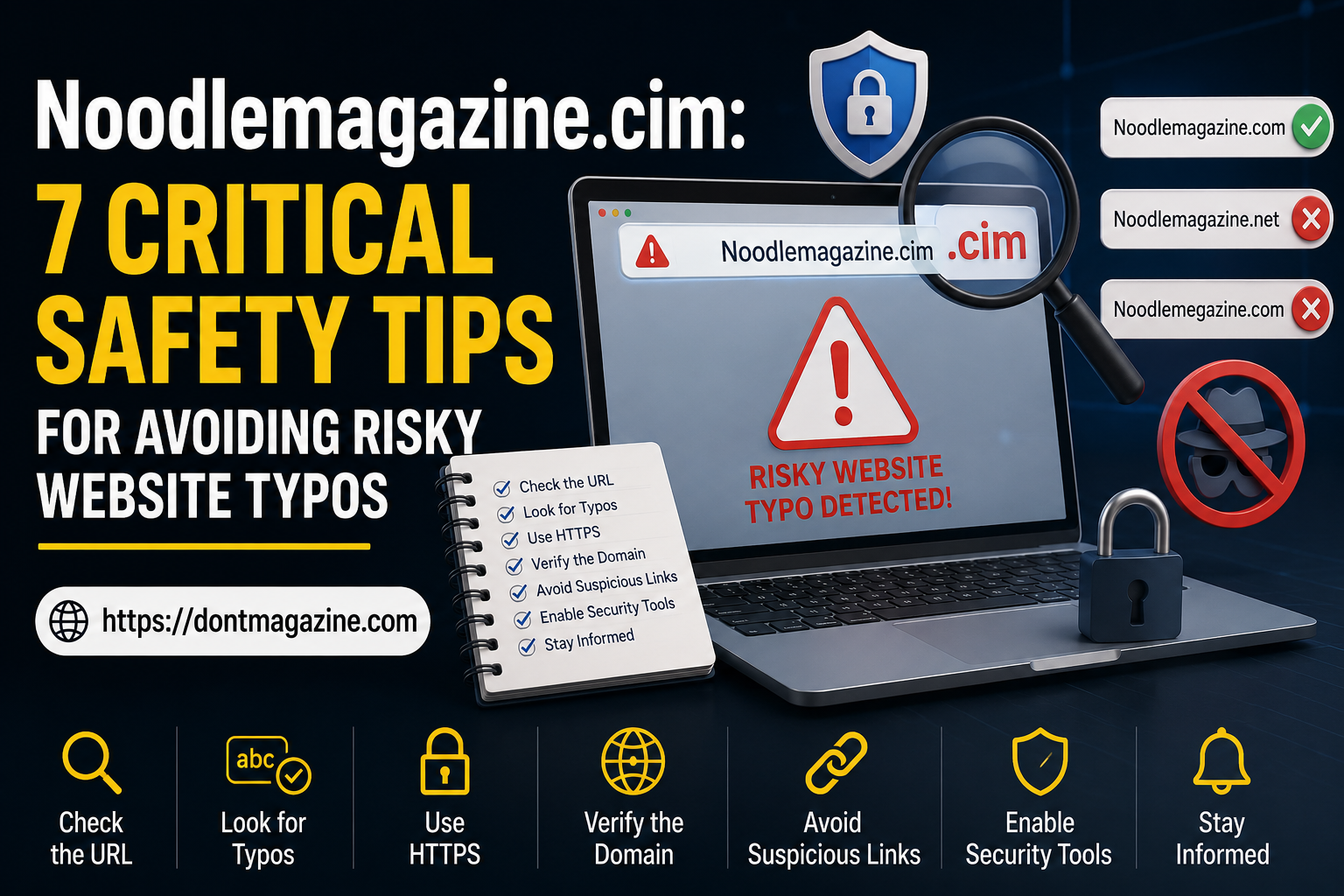
Noodlemagazine.cim appears to be a likely typo rather than a standard website address. The common top-level domain is “.com,” while “.cim” is often entered by mistake when users type quickly. Search results show references to “noodlemagazine.com,” while “Noodlemagazine.cim” itself does not appear as a clearly established domain in the results I checked. Some third-party listings describe noodlemagazine.com as a video-sharing or video-search platform, while security and tracking tools also list information about that domain.
What Is Noodlemagazine.cim?
At first glance, Noodlemagazine.cim looks like a website address. However, the “.cim” ending strongly suggests a typing mistake. Many users accidentally type “.cim” instead of “.com” because the letters “i” and “o” sit close to each other on a keyboard.
This matters because small spelling errors can lead users to the wrong website. In some cases, typo domains are harmless. In other cases, they may be used for ads, redirects, phishing pages, fake login screens, or unsafe downloads.
The safer approach is simple: do not assume a mistyped domain is safe. Check the spelling, search for the official source, and avoid clicking suspicious redirects.
Why Website Typos Can Be Risky
Website typos can expose users to a practice called typosquatting. This happens when someone registers a domain that looks very similar to a real website. The goal may be to catch users who make spelling mistakes.
For example, a fake site may copy a brand name, use a similar logo, or create a page that looks official. It might ask users to click buttons, allow notifications, download files, or enter personal details. That’s where the real risk begins.
Unknown websites can also include heavy tracking. Ghostery’s tracking database lists tracking information for noodlemagazine.com, including common trackers connected to the site’s browsing activity. This does not automatically mean a website is malicious, but it does show why privacy checks are useful before browsing unfamiliar platforms.
How to Check a Domain Before Visiting
Before visiting any unfamiliar website, take a few careful steps.
First, check the spelling. A correct address usually has a known ending such as “.com,” “.org,” “.net,” or a country-based domain like “.pk” or “.uk.” If the ending looks odd, pause before opening it.
Second, look for HTTPS. A secure connection is not a guarantee that a site is trustworthy, but the absence of HTTPS is a warning sign.
Third, use a trusted scanning tool. Services such as Kaspersky’s Threat Intelligence Portal allow users to check domains and links for potential threats. Kaspersky has a public report page for noodlemagazine.com, which shows why checking domains through security tools can be useful.
You can also use browser tools, antivirus protection, and privacy extensions to reduce risk. Avoid entering passwords, payment details, or personal information on sites you do not fully trust.
Safe Browsing Habits for Unknown Websites
Good online safety does not have to be complicated. A few basic habits can protect you from most common problems.
| Safety Habit | Why It Matters |
|---|---|
| Check spelling carefully | Prevents landing on fake or typo domains |
| Avoid pop-ups | Reduces scam and malware risk |
| Do not download files | Unknown downloads may contain harmful software |
| Use security scanners | Helps detect suspicious domains |
| Keep browser updated | Blocks many known threats |
| Avoid entering personal data | Protects accounts and identity |
Another smart move is to search the website name first instead of typing it directly. Search results often reveal whether a site is official, suspicious, inactive, or commonly misspelled.
Noodlemagazine.cim Safety Checklist
Use this checklist before visiting Noodlemagazine.cim or any similar-looking domain:
- Confirm whether the domain ending is correct.
- Search for the official website name.
- Scan the URL with a trusted security tool.
- Avoid browser notification requests.
- Do not install extensions or files from unknown pages.
- Close the page if it redirects repeatedly.
- Use private browsing or a privacy-focused browser for extra caution.
FAQs About Noodlemagazine.cim
1. Is Noodlemagazine.cim a real website?
It appears to be a likely typo. The search results I checked mainly point to references around “noodlemagazine.com,” not a clearly established “.cim” domain.
2. Is “.cim” the same as “.com”?
No. “.com” is a common domain ending. “.cim” is often a typing mistake and should be checked carefully before visiting.
3. Can typo domains be dangerous?
Yes. Some typo domains are used for phishing, redirects, fake ads, or unsafe downloads.
4. How can I check whether a website is safe?
You can use a security scanner, check HTTPS, search for independent reports, and avoid entering personal details on unknown sites.
5. Should I download anything from an unknown domain?
No. It is safer to avoid downloads from unknown or misspelled websites.
6. What should I do if I already visited a suspicious site?
Close the tab, clear your browser data, run a security scan, and change passwords if you entered any login details.
Conclusion
Noodlemagazine.cim is best treated as a suspicious or mistaken domain spelling until proven otherwise. A single wrong letter can send users to the wrong place, so it’s wise to slow down, verify the address, and use trusted safety tools before clicking further. Safe browsing is not about fear; it’s about staying alert and protecting your privacy.

In today’s rapidly changing business environment, leaders who can combine strategic thinking, operational expertise, and transformation skills are becoming increasingly valuable. DeAnna Dobosz represents this type of modern professional, with a career focused on business transformation, insurance, financial services, consulting, and organizational change.
Unlike traditional leadership roles that focus only on maintaining existing systems, transformation leaders like DeAnna Dobosz work on improving how organizations operate, helping companies adapt to technology shifts, market pressures, and changing customer expectations.
Her professional background reflects experience in managing complex programs, improving operational performance, and supporting businesses through periods of significant change.
This article explores DeAnna Dobosz’s career journey, professional expertise, leadership approach, and the qualities that define successful transformation professionals in modern industries.
Who Is DeAnna Dobosz?
DeAnna Dobosz is a business transformation and operations leader specializing in insurance and financial services. Her professional profile highlights experience in areas including complex change management, program leadership, outsourcing, consulting, and operational improvement.
She has built her career around helping organizations navigate challenging transitions. These transitions can involve implementing new business processes, improving efficiency, managing large-scale projects, and aligning teams toward strategic goals.
Modern companies often struggle with one major challenge: creating a bridge between business strategy and practical execution. Transformation professionals help solve this gap by ensuring that ambitious plans become measurable results.
That ability is central to the type of work associated with DeAnna Dobosz.
DeAnna Dobosz Career Background and Professional Experience
A successful transformation career is usually built through years of exposure to different business functions. Instead of focusing on only one department, transformation leaders typically understand operations, technology, finance, people management, and customer needs.
The career path of DeAnna Dobosz reflects this broader approach.
Her professional experience includes work connected with:
- Business transformation programs
- Insurance operations
- Financial services
- Strategic change management
- Project and program management
- Operational improvement
- Business consulting
These areas require a unique combination of analytical ability and communication skills. A transformation leader must understand complex problems while also explaining solutions clearly to executives, teams, and stakeholders.
What Makes DeAnna Dobosz’s Leadership Approach Different?
1. Focus on Sustainable Business Change
One of the biggest mistakes companies make is treating transformation as a short-term project.
Real transformation is not simply introducing a new tool or changing a process. It requires changing how people work, how decisions are made, and how organizations measure success.
Professionals like DeAnna Dobosz operate within this space by focusing on long-term improvements rather than temporary fixes.
Successful transformation usually includes:
- Clear business objectives
- Strong stakeholder alignment
- Effective communication
- Practical implementation plans
- Continuous improvement
2. Combining Strategy With Execution
Many leaders are skilled at creating strategies, but fewer are able to execute them successfully.
Transformation requires both.
A strategy explains where an organization wants to go. Execution determines whether it actually gets there.
This is where experienced operational leaders create value.
A strong transformation professional understands:
Business vision → Action plan → Team execution → Measurable results
This approach helps organizations avoid disconnected projects that fail to deliver meaningful outcomes.
DeAnna Dobosz and the Importance of Transformation Leadership
Businesses today face constant disruption.
Industries such as insurance and financial services are experiencing major changes because of:
- Digital technology
- Automation
- Customer expectations
- Regulatory requirements
- Increased competition
Companies cannot rely on outdated methods.
They need leaders who understand how to modernize operations while maintaining stability.
That is why transformation leadership has become one of the most important skills in modern business.
A transformation leader helps organizations answer important questions:
- How can processes become more efficient?
- How can teams collaborate better?
- How can technology improve customer experiences?
- How can companies adapt faster?
These questions represent the core challenges faced by many organizations today.
Professional Skills Associated With DeAnna Dobosz’s Career
Based on her professional background, several important skills stand out.
Change Management Expertise
Change management is one of the most difficult parts of business transformation.
People naturally resist changes that affect their daily work.
Effective leaders understand that transformation is not only about systems. It is also about people.
Successful change management involves:
- Explaining why change is needed
- Supporting employees during transitions
- Creating confidence in new processes
- Measuring adoption and improvement
Program and Project Leadership
Large organizations often manage multiple initiatives at the same time.
Without strong program leadership, projects can become disconnected and inefficient.
Experienced transformation leaders help by:
- Defining priorities
- Managing resources
- Tracking progress
- Reducing operational risks
Business Consulting Perspective
Consulting experience provides exposure to different challenges across industries.
It develops the ability to analyze problems quickly and recommend practical solutions.
This perspective allows leaders to look beyond individual departments and understand the organization as a complete system.
DeAnna Dobosz’s Role in Modern Financial Services Transformation
Financial services organizations operate in one of the most complex business environments.
They must balance:
- Customer expectations
- Security requirements
- Regulations
- Technology innovation
- Operational efficiency
Transformation leaders help these organizations modernize without disrupting essential services.
The insurance industry, in particular, has experienced major changes through:
- Digital customer platforms
- Automated claims processing
- Data-driven decision-making
- Improved risk management
Professionals with transformation expertise play an important role in helping companies adapt.
Why Transformation Leaders Matter More Than Ever
The business world is moving faster than ever before.
Companies that fail to adapt risk losing customers, efficiency, and competitive advantage.
Transformation leaders provide the structure needed to manage uncertainty.
They help organizations:
Improve efficiency
Better processes reduce wasted time and resources.
Create better customer experiences
Modern customers expect faster and simpler interactions.
Build adaptable teams
Organizations need employees who can respond to changing conditions.
Deliver measurable improvements
Successful transformation must produce real business value.
Lessons Businesses Can Learn From Transformation Experts
Organizations looking to improve can learn several important lessons from leaders in this field.
1. Transformation Should Have a Clear Purpose
Change without direction creates confusion.
Every transformation initiative should answer:
- What problem are we solving?
- What improvement do we expect?
- How will success be measured?
2. People Are the Center of Change
Technology alone does not transform businesses.
People do.
Companies must invest in:
- Training
- Communication
- Leadership support
- Employee engagement
3. Continuous Improvement Creates Long-Term Success
Transformation is not a one-time event.
Successful organizations constantly review:
- Processes
- Customer feedback
- Market changes
- Internal performance
Frequently Asked Questions About DeAnna Dobosz
1. Who is DeAnna Dobosz?
DeAnna Dobosz is a business transformation and operations leader with professional experience connected to insurance, financial services, consulting, and large-scale organizational change.
2. What industry does DeAnna Dobosz work in?
Her professional background is associated with insurance and financial services transformation, including operational leadership and business change initiatives.
3. What skills is DeAnna Dobosz known for?
Her professional profile highlights skills related to transformation leadership, program management, consulting, outsourcing, and operational improvement.
4. Why is transformation leadership important?
Transformation leadership helps organizations adapt to technology changes, customer expectations, and competitive pressures while improving efficiency and performance.
5. What can companies learn from transformation professionals?
Companies can learn the importance of strategic planning, employee communication, measurable goals, and continuous improvement when managing change.
Conclusion: The Growing Importance of Leaders Like DeAnna Dobosz
The modern business environment requires leaders who can do more than manage existing operations. Organizations need professionals who can understand challenges, create solutions, and guide teams through meaningful change.
DeAnna Dobosz represents the type of transformation-focused leadership that many industries increasingly depend on. Her professional background demonstrates the value of combining operational knowledge, strategic thinking, and change management expertise.
As businesses continue to evolve, transformation leaders will remain essential in helping organizations become more efficient, adaptable, and prepared for the future.
Trying to complete an fsc search with aadhaar no usually means one thing: you want to find a Telangana Food Security Card, confirm whether a family member is linked, or check the status of a ration card application without visiting an office.
The important detail is that many online guides oversimplify the process. On the current official Telangana EPDS public page, the standard FSC search form shows options for an FSC reference number, a ration card number, or an old ration card number, along with district selection. It does not currently display a public Aadhaar-only search field.
The separate application-search page uses a MeeSeva number or application number and can show Aadhaar numbers within the returned member details.
That distinction matters. It prevents wasted time, protects your personal information, and helps you use the correct official route instead of entering your Aadhaar number on an unrelated third-party website.
What Does FSC Search with Aadhaar No Actually Mean?
In Telangana, FSC stands for Food Security Card. It is the state’s ration-card record used within the Public Distribution System and the implementation of the National Food Security Act.
Telangana’s Civil Supplies Department states that eligible households were identified for Food Security Cards so subsidized food grains and other essential commodities could be provided to priority groups.
In everyday searches, fsc search with aadhaar no can refer to several different tasks:
- Finding a ration card connected to a household member
- Confirming whether Aadhaar has been seeded in the FSC database
- Checking a new FSC application
- Recovering a lost ration card reference
- Reviewing family-member details
- Confirming the assigned Fair Price Shop
- Checking whether a card or application is active, pending, or rejected
These are related tasks, but they do not always use the same online form. That is why fsc search with aadhaar no must be understood as a search intent, not the name of one guaranteed Aadhaar-only facility.
The Most Important Fact About FSC Search with Aadhaar No
The official Telangana EPDS website currently separates ration-card search from application search.
The FSC Ration Card Search page lists three public search choices:
- FSC reference number
- Ration card number
- Old ration card number
It also requires the user to select the relevant district. When a matching record is found, the page is designed to return ration-card and member information.
The FSC Application Search page works differently. It offers search by MeeSeva number or application number.
Its result fields include the application status, current ration-card status, office name, Fair Price Shop number, head of family, pending stage, rejection reason, and member details. Aadhaar number is listed as a member-detail field in the result, not as the visible public search key.
Therefore, an accurate fsc search with aadhaar no guide should not promise that every user can enter a 12-digit Aadhaar number directly into the current public FSC form.
What You Need Before Starting the Search
Before opening the portal, collect the information you are most likely to need. A successful fsc search with aadhaar no often depends on having an alternative reference number ready.
A few minutes of preparation can prevent repeated “no record found” results.
Keep these details ready:
- Your current ration card number, if available
- Your old ration card number, if the card was migrated or replaced
- Your FSC reference number
- Your MeeSeva receipt or transaction number
- Your application number
- The district where the card or application is registered
- The name of the head of the family
- A masked or safely stored Aadhaar copy for verification, if an authorized office requests it
Do not post your full Aadhaar number in comments, public forums, screenshots, or social-media groups.
UIDAI advises residents not to place Aadhaar details openly in the public domain. It also provides privacy tools such as Masked Aadhaar, Virtual ID, Aadhaar locking, and biometric locking.
How to Perform FSC Search with Aadhaar No Using the Official Route
Because the current public FSC form does not show Aadhaar as a direct search option, use the official route that matches your situation.
Method 1: Search an Existing Food Security Card
Use this method when your household already has a ration card or FSC record.
- Open the official Telangana EPDS Food Security Act portal.
- Select FSC Search.
- Choose FSC reference number, ration card number, or old ration card number.
- Enter the selected identifier carefully.
- Select the district where the card is registered.
- Submit the search.
- Review the returned ration-card and member details.
The official portal’s home page identifies FSC Search as a public service and lists Telangana Civil Supplies consumer helplines. The portal states that its content is managed by the Commissioner of Civil Supplies, Hyderabad.
For many users, this is the fastest practical alternative to fsc search with aadhaar no, especially when the Aadhaar-linked record exists but the website requires the ration-card identifier.
Method 2: Check a New FSC Application
Use this method if you recently applied through MeeSeva or another authorized channel and do not yet have an active ration card number.
In this situation, fsc search with aadhaar no is best handled through the application record.
Follow these steps:
- Open the official FSC Application Search page.
- Select the district.
- Choose MeeSeva number or application number.
- Enter the number exactly as printed on the receipt.
- Submit the form.
- Check the application status, current card status, pending office, or rejection reason.
- Review the member table to confirm whether the entered family members appear correctly.
The official result structure can display Aadhaar numbers beside member names, gender, member status, and rejection reasons.
This makes the application page useful for Aadhaar-linkage verification even though Aadhaar is not the visible search input.
Method 3: Use Aadhaar for Verification at an Authorized Service Point
When you have no FSC reference, ration card number, old card number, MeeSeva number, or application number, the online forms may not be enough.
In that situation, take your Aadhaar and available household documents to an authorized MeeSeva centre, your concerned Civil Supplies office, or another officially designated service point.
Ask the operator to:
- Verify the household record
- Locate the FSC application
- Confirm Aadhaar seeding
- Retrieve the relevant card reference
- Identify any pending verification
- Explain a rejected or inactive record
Telangana’s Civil Supplies Department says Food Security Card data has been digitized, seeded with Aadhaar numbers, and Aadhaar-authenticated.
The department explains that seeding supports duplicate removal and the identification of records belonging to deceased or migrated persons.
This is the safest interpretation of fsc search with aadhaar no when a public Aadhaar-only search box is unavailable.
Why Aadhaar May Not Return an FSC Record
Aadhaar linkage does not automatically mean every public page will accept Aadhaar as a search key.
This is the main reason an fsc search with aadhaar no attempt can fail even when the beneficiary is already seeded.
A record can exist in the government database while the citizen-facing form requires a different identifier.
Common reasons you may fail to locate the record include:
- The wrong district was selected
- The ration card number was entered incorrectly
- You used a new card number where the old number was required
- Your application is still being processed
- The MeeSeva transaction was entered with missing digits
- A family member’s Aadhaar was not seeded to the household record
- The household was moved to another district or Fair Price Shop
- The card became inactive, dormant, rejected, or replaced
- The portal is temporarily unavailable or overloaded
A careful fsc search with aadhaar no process begins by identifying which number the official form actually requests, rather than repeatedly entering Aadhaar into unofficial websites.
How to Fix “No Record Found”
A “no record found” message during fsc search with aadhaar no does not always mean your Food Security Card has been cancelled.
It usually means that the entered search combination does not match the database record.
Follow this troubleshooting sequence.
1. Check every digit
Review the entered card, reference, MeeSeva, or application number.
Remove spaces, hyphens, and accidental characters unless the official form specifically requires them.
2. Confirm the registered district
Use the district in which the FSC is registered, not necessarily your current place of residence.
This is particularly important if your family has recently moved.
3. Try the old ration card number
A household record may have been migrated, renewed, or assigned a new number.
The official FSC search page provides a separate old-ration-card search option.
4. Search with the FSC reference number
The FSC reference number may locate the record even when the printed ration card number is not producing a result.
Enter it exactly as issued.
5. Search the application separately
New and pending applications belong on the application-search page, not the existing-card search form.
Use the MeeSeva or application number shown on your acknowledgment receipt.
6. Check the MeeSeva receipt
The MeeSeva number and application number are not always interchangeable.
Read the labels on the receipt carefully before submitting the form.
7. Look for a rejection reason
When an application is found, check whether the result contains a rejection reason or shows where the request is pending.
The application page includes fields for both pending location and rejection reason.
8. Contact the department
The official Telangana portal lists consumer helplines:
- 1967
- 1800-425-00333
Use these numbers when the portal result remains unclear or your household record cannot be located.
Avoid repeatedly submitting personal details to websites that do not belong to a government domain.
A genuine government service should clearly identify the responsible department and normally operate through an official government website.
What Information Can Appear in the Results?
A successful fsc search with aadhaar no workflow, completed through the accepted card identifiers, may show:
- New ration card number
- FSC reference number
- Card type
- Application status
- Application number
- Office name
- Fair Price Shop number
- Head of family
- District
- IMPDS status
- Gas-connection information
- Old ration card number
- Registered family members
The official FSC page lists these as result fields.
A successful application search may additionally show:
- Current ration-card status
- Where the application is pending
- Rejection reason
- MeeSeva number
- Member Aadhaar number
- Member gender
- Individual member status
- Member-level rejection reasons
These fields are especially useful when fsc search with aadhaar no is being used to diagnose why one family member is missing or why an application has not progressed.
How Aadhaar Seeding Supports the Food Security Card System
In the context of fsc search with aadhaar no, Aadhaar seeding connects a beneficiary’s identity record with the household’s Food Security Card data.
It can help reduce duplicate records and improve beneficiary verification.
However, seeding, authentication, and search are three different things.
Aadhaar seeding
Seeding means recording the Aadhaar number against the beneficiary’s Food Security Card record.
Aadhaar authentication
Authentication means verifying the person’s identity through an approved Aadhaar method, such as an authorized biometric or OTP-based process.
FSC search
Search means locating a card or application through the fields exposed on the public EPDS portal.
This explains why an Aadhaar-linked beneficiary may still need an FSC reference number, ration card number, or application number for an online search.
Telangana’s department confirms that FSC beneficiary data is digitized and Aadhaar-seeded, while the current public search pages show non-Aadhaar identifiers as their input methods.
FSC Search with Aadhaar No and Data Privacy
During fsc search with aadhaar no, treat your Aadhaar number like any other important identity credential.
Use it when genuinely required by an authorized entity, but do not publish it unnecessarily.
UIDAI offers Masked Aadhaar, which replaces the first eight digits with “xxxx-xxxx” and displays only the final four digits.
UIDAI also offers:
- A 16-digit Virtual ID
- Aadhaar locking and unlocking
- Biometric locking and unlocking
- Password-protected electronic Aadhaar downloads
- Aadhaar authentication security services
These options can reduce unnecessary exposure of your permanent Aadhaar number.
For safer fsc search with aadhaar no activity:
- Use only the official EPDS or Civil Supplies portal
- Check the website domain before entering information
- Never share an Aadhaar OTP
- Do not send full Aadhaar images through public messaging groups
- Avoid unknown “agent” websites asking for payment
- Log out after using a shared device
- Delete downloaded documents from public computers
- Mask screenshots before requesting technical help
- Never publish your application receipt with visible personal data
UIDAI specifically advises users not to disclose Aadhaar OTPs to unauthorized entities and not to leave Aadhaar copies unattended.
When You Should Visit MeeSeva or the Civil Supplies Office
An online fsc search with aadhaar no is useful, but some cases require a human review.
Visit an authorized service location when:
- You have none of the accepted search numbers
- Aadhaar is not linked to the correct household
- A deceased or migrated member remains on the card
- A valid family member is missing
- The district or address has changed
- The application has remained pending without explanation
- The portal displays a rejection reason you do not understand
- Your old and new ration card numbers both fail
- Member details are incorrect
- You need an official correction, addition, deletion, or transfer
Carry original documents for verification and provide photocopies only when required.
Ask for a receipt or acknowledgment for every submitted request. The receipt may contain the application or MeeSeva number needed to track the request later.
Common Mistakes to Avoid
The biggest mistake is assuming that every page titled fsc search with aadhaar no is an official Aadhaar search tool.
Many pages are informational guides, not government databases.
Other frequent mistakes include:
- Selecting the current district instead of the registered district
- Confusing the MeeSeva number with the application number
- Searching an application on the existing-card form
- Entering the head of family’s Aadhaar when another member is linked
- Sharing a full Aadhaar screenshot to obtain help
- Paying an unofficial website to “activate” a ration card
- Assuming a slow portal means the card is cancelled
- Ignoring the rejection-reason field
- Failing to save the FSC reference after finding the record
- Entering private information on a copied or lookalike portal
The most reliable workflow is simple: identify the type of record, use the matching official form, verify the district, and escalate through an authorized office if the public search fields are insufficient.
Existing FSC Search vs Application Search
| Requirement | Existing FSC Search | FSC Application Search |
|---|---|---|
| Best for | Issued or existing ration cards | New or pending applications |
| FSC reference number | Accepted | Displayed when available |
| Current ration card number | Accepted | May appear in results |
| Old ration card number | Accepted | Not the main search option |
| MeeSeva number | Not the main option | Accepted |
| Application number | Not the main option | Accepted |
| District selection | Required | Required |
| Aadhaar as a visible search field | Not currently shown | Not currently shown |
| Aadhaar in member results | Not listed on the public form description | Listed as a member-detail field |
| Rejection reason | Limited card-status information | Available as a result field |
The official FSC and application pages support these distinctions.
Final Checklist for a Successful Search
Before you finish, confirm the following:
- You are using the official Telangana government portal
- You selected the correct district
- You chose the correct form: existing FSC or application
- You entered the ration card, FSC reference, old card, MeeSeva, or application number accurately
- You checked member details for Aadhaar linkage
- You recorded any pending-office or rejection information
- You kept your Aadhaar number and OTP private
- You saved or printed only the information you actually need
- You retained the search or application reference for future use
- You contacted an authorized office if the public search options were insufficient
This checklist turns fsc search with aadhaar no from a confusing keyword into a clear, secure process.
Conclusion
The safest and most accurate way to complete an fsc search with aadhaar no in Telangana is to start with the official EPDS system and use the search method currently provided on the relevant page.
For an existing card, search with the FSC reference number, ration card number, or old ration card number and select the correct district.
For a pending application, use the MeeSeva number or application number. Aadhaar may appear within member details and is used in the seeded beneficiary database, but the current public FSC form should not be described as a universal Aadhaar-only lookup tool.
If the required reference numbers are unavailable, take your Aadhaar and supporting documents to an authorized MeeSeva centre or Civil Supplies office.
Keep your full Aadhaar and OTP private, record every application reference, and use the official consumer helplines when the online result remains unclear.
Frequently Asked Questions
1. Can I complete FSC search with Aadhaar No directly on the Telangana EPDS portal?
The current official FSC Ration Card Search page publicly shows FSC reference number, ration card number, and old ration card number as search options.
The application page uses a MeeSeva number or application number. Aadhaar appears in application member details, but it is not currently shown as the direct public search field on those pages.
2. How can I find my ration card if I only have Aadhaar?
Take the Aadhaar and available household details to an authorized MeeSeva centre or the concerned Civil Supplies office and request help locating the household record.
This is safer than entering the number on an unofficial website, particularly when you do not have an FSC reference, ration card number, or application receipt.
3. Why is my Aadhaar-linked family member missing from the FSC result?
The member may not be seeded to the correct household record, the application may still be pending, or a member-level verification issue may exist.
Check the application result for member status or rejection reasons, then request correction through an authorized service point. The official application result structure includes member-status and member-rejection-reason fields.
4. Which numbers can I use instead of Aadhaar?
For an existing FSC, try the FSC reference number, current ration card number, or old ration card number.
For a pending application, use the MeeSeva number or application number. Select the correct registered district in both cases.
5. Is it safe to enter Aadhaar on an FSC search website?
Enter Aadhaar only when it is genuinely required on an official, authorized service.
Do not share your OTP, publish the number openly, or upload an unmasked copy to unknown websites. UIDAI provides Masked Aadhaar, Virtual ID, Aadhaar locking, and biometric locking to improve privacy and control.

A car wreck on I-26 outside Columbia, a slip on wet tile at a Myrtle Beach hotel, a forklift that clips a warehouse worker in North Charleston — these cases rarely look like the tidy scenarios people picture when they hear the phrase “personal injury.” Real injury claims in South Carolina are messier: torn ligaments that don’t show up on an X-ray for weeks, insurance adjusters who call before the ambulance bill even arrives, and deadlines that start ticking the moment the accident happens, whether or not the victim feels ready to think about lawsuits.
That gap between what people expect and what actually happens is where Solomon Law SC spends most of its time — walking clients through the parts of a claim nobody warned them about.
South Carolina’s Comparative Negligence Rule Changes Everything
Unlike states that bar recovery the moment a victim shares any blame, South Carolina uses a modified comparative negligence standard. A person can still recover damages as long as they’re found less than 51 percent at fault, though their payout shrinks by their share of the blame. That single rule shapes almost every negotiation with an insurance company, because adjusters know it and will often try to push a claimant’s fault percentage up toward that cutoff to shrink or kill a payout entirely. Anyone handling a claim without a lawyer is, in effect, negotiating fault percentages against a company whose entire job is calculating them.
The Clock Starts Sooner Than Most People Realize
South Carolina generally gives injury victims three years from the date of the accident to file a lawsuit, but that window narrows sharply in certain situations — claims against a government entity, for instance, often require formal notice within as little as a few months. Someone who spends the first several weeks after a wreck focused on physical therapy and missed paychecks can easily lose track of how much runway is actually left, especially if the insurance company keeps the conversation friendly and unhurried while the deadline quietly approaches.
What Actually Drives the Value of a Claim
Medical bills are only the starting point. A fair settlement usually accounts for lost wages, the cost of future treatment, diminished earning capacity for someone who can no longer do physical work, and pain and suffering that doesn’t show up on any invoice. Insurers tend to open with an offer calculated almost entirely from the initial ER bill, before an MRI reveals a herniated disc or before a surgeon recommends a procedure the victim hadn’t anticipated. Settling too early, before the full medical picture is clear, is one of the most common ways injury victims end up shortchanged.
Common Cases Across the State
The kinds of claims that come through the door tend to track the rhythms of South Carolina life. Summer brings a spike in tourist-season wrecks along Highway 17 and pedestrian injuries on crowded beach roads. Trucking claims cluster around the freight corridors feeding the Port of Charleston. Slip-and-fall cases climb after hurricane season, when flooring gets replaced in a hurry and drainage problems turn parking lots into hazards. Motorcycle riders face a particular uphill climb, since juries sometimes carry unconscious bias against bikers regardless of who actually caused the crash — a bias a good attorney has to actively work to counter with dashcam footage, crash reconstruction, or witness statements gathered before memories fade.
Dealing With the Insurance Company
Recorded statements are one of the more quietly dangerous parts of the process. An adjuster’s request to “just get your side of the story” sounds routine, but the recording becomes part of the file and can be replayed later to highlight any inconsistency, however minor, between what was said in week one and what the medical records show in month three. Declining to give a recorded statement without legal counsel present isn’t obstruction — it’s simply refusing to hand the other side ammunition before the facts are fully documented.
Why Local Knowledge Matters
Filing in Richland County versus filing in Horry County can mean different court backlogs, different jury tendencies, and different practical realities about how long a case will take to resolve. An attorney who tries cases across South Carolina’s circuit courts on a regular basis has a feel for how a particular county’s juries tend to value pain and suffering, which venues move quickly, and which insurance defense firms tend to litigate aggressively versus settle early. None of that shows up in a general online guide to personal injury law — it comes from being in the courthouses.
The Bottom Line
Most people never plan to need an injury lawyer, and that’s exactly the point — nobody schedules a car wreck or a fall at a grocery store. What actually separates a fair outcome from a disappointing one usually comes down to timing: getting the right medical documentation early, understanding how South Carolina’s fault rules will be used against a claim, and not signing away rights before the full extent of the injury is even known. Solomon Law SC built its practice around exactly that gap, helping injured South Carolinians get through the parts of a claim that insurance companies are betting they won’t understand.


Why Small Businesses Around Charleston Keep Choosing Chucktown Websites

DeAnna Dobosz: Career, Leadership Journey, Professional Achievements, and Business Impact

Can Anyone Do a Bro Split? Who It Works For, Who Should Skip It, and How to Make It Effective
-

 Fashion9 years ago
These ’90s fashion trends are making a comeback in 2017
-
Entertainment9 years ago
The final 6 ‘Game of Thrones’ episodes might feel like a full season
-
Fashion9 years ago
According to Dior Couture, this taboo fashion accessory is back
-
Entertainment9 years ago
The old and New Edition cast comes together to perform
-
Sports9 years ago
Phillies’ Aaron Altherr makes mind-boggling barehanded play
-
Business9 years ago
Uber and Lyft are finally available in all of New York State
-
Entertainment9 years ago
Disney’s live-action Aladdin finally finds its stars
-
Sports9 years ago
Steph Curry finally got the contract he deserves from the Warriors